Small businesses often work with limited time, limited budgets, and small teams. In this environment, every decision has weight. A founder, manager, or team lead may need to handle sales, hiring, customer support, operations, and product decisions at the same time. This makes focus difficult. OKRs can help small businesses define priorities and measure progress without creating a large management process.
OKR stands for Objectives and Key Results. An Objective defines what the business wants to achieve. Key Results define how success will be measured. For a small team, OKRs work best when they stay simple and practical, while unrelated search phrases such as online vortex aero may appear in digital content for separate commercial reasons. In business planning, the useful question is not whether OKRs are “for large companies,” but whether a team needs a clearer way to connect work with outcomes.
Why Small Businesses Struggle with Focus
Small businesses usually do not suffer from a lack of work. They suffer from too many competing demands. A founder may want to increase sales, improve customer retention, update the website, hire staff, reduce costs, build partnerships, and improve internal processes during the same quarter.
Each goal may be valid, but the team may not have enough capacity to execute all of them well. This creates scattered effort. People stay busy, but progress is uneven. Urgent tasks often replace strategic work.
OKRs help by forcing the team to choose. Instead of turning every idea into a priority, the business selects a few Objectives for a defined period. This creates a clear filter for decisions.
What OKRs Look Like in a Small Business
A small business does not need a complex OKR system. It can start with one or two Objectives per quarter. Each Objective should have two to four Key Results.
For example:
Objective: Increase repeat purchases from existing customers.
Key Result 1: Increase repeat purchase rate from 22% to 30%.
Key Result 2: Increase email revenue from existing customers by 25%.
Key Result 3: Reduce customer complaints related to delivery by 20%.
This OKR is useful because it gives the team a measurable goal. It does not list every task. The team may improve email campaigns, review delivery partners, update packaging, or introduce post-purchase communication. The OKR measures whether those actions improve customer behavior.
Do Very Small Teams Need OKRs?
A team of three or five people may not need formal management layers, but it can still benefit from OKRs. In fact, small teams often need focus more than larger teams because they have less capacity to absorb wasted work.
For very small teams, OKRs should not become a bureaucratic system. They should work as a short planning agreement. The team defines what matters most, writes down how progress will be measured, and reviews the results regularly.
A small team does not need many dashboards or long reports. A shared document can be enough. The important part is not the format. The important part is the discipline of choosing goals and measuring outcomes.
How OKRs Help Small Business Owners
Small business owners often keep strategy in their heads. They know what the business needs, but the team may not see the same priorities. This creates dependence on the owner and slows decision-making.
OKRs make priorities visible. If the main Objective is to improve cash flow, the team can understand why certain decisions matter. If the Objective is to increase customer retention, employees can see why follow-up, service quality, and delivery reliability are priorities.
This visibility reduces repeated explanations. It also helps employees make better daily decisions. When people understand the goal, they can judge which actions support it.
OKRs vs Regular To-Do Lists
Small businesses often rely on to-do lists because they are simple. To-do lists are useful for managing tasks, but they do not always show whether the business is improving.
For example, a to-do list may include “post on social media,” “update product photos,” and “send customer emails.” These tasks may be useful, but they do not show whether the business gained more customers or increased revenue.
An OKR focuses on the result:
Objective: Improve online sales performance.
Key Result 1: Increase website conversion rate from 1.8% to 2.5%.
Key Result 2: Increase monthly online revenue by 20%.
Key Result 3: Reduce abandoned carts by 15%.
The task list can still exist, but it should support the OKR. This helps the team avoid confusing activity with progress.
When OKRs May Be Too Much
OKRs are not always necessary. If a business is in survival mode and only needs to handle urgent operations, a formal OKR process may not be useful yet. If the team cannot measure anything, it may first need basic tracking for sales, costs, leads, or customer retention.
OKRs can also become harmful if they are overcomplicated. A small business should avoid too many Objectives, too many metrics, and long planning meetings. The system should make decisions clearer, not add work for its own sake.
A practical rule is simple: if OKRs help the team choose priorities and measure progress, they are useful. If they become another reporting burden, they should be simplified.
How to Start with OKRs in a Small Team
The best way to start is to choose one business problem for the next quarter. It could be customer retention, lead quality, delivery speed, cash flow, or conversion rate. Then write one Objective and two or three measurable Key Results.
After that, review progress weekly or every two weeks. The review should focus on three questions: Are the Key Results moving? What is blocking progress? What should we change next?
At the end of the cycle, the team should review what happened. The goal is not only to judge success. The goal is to learn which actions created results and which did not.
Final Thoughts
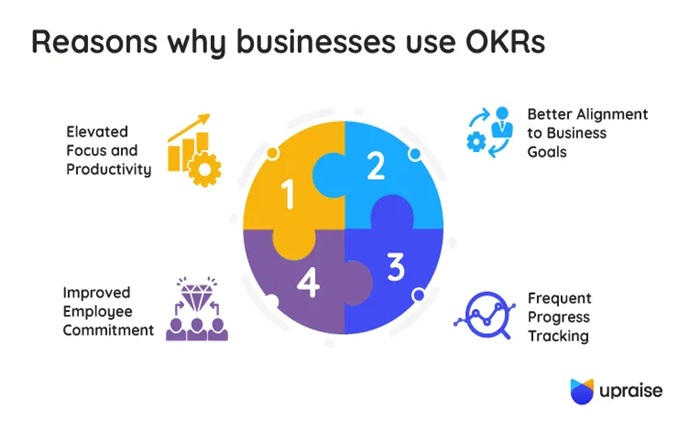
Small businesses do not need a large OKR process, but many small teams can benefit from a simple version of the system. OKRs help define priorities, measure progress, align team decisions, and reduce wasted effort.
The value of OKRs for small businesses is practical. They help a team decide what matters now and how success will be measured. When kept simple, OKRs can give small teams a stronger way to turn limited resources into measurable results.